No. 11 · 18 June 2026
The Most Important Hours of Your Day
Why the body’s deepest repair happens during sleep
We often think health is only shaped by what we do during the day.
Food, movement, supplements, and daily routines.
But many of the body’s most important restorative processes happen while we sleep.

Sleep is not simply rest. It is one of the most biologically active periods of the day.
During this time, the nervous system shifts into repair mode. Hormones rebalance. Muscles recover. The brain carries out essential restoration and processing.
And yet, in modern life, sleep is often compromised in favour of productivity, stimulation, entertainment, or simply trying to fit more into the day.
For a long time, I completely underestimated how much this mattered. A few years ago, I was often sleeping only five to six hours per night, and it felt normal. Only after I began paying more attention to simple sleep rituals did I notice a real change. Today, I sleep closer to seven to eight hours on average, and the difference is clear. My sleep feels deeper, I wake up more refreshed, and overall energy and clarity have noticeably improved.
In this edition:
• Why sleep may be one of the most important foundations of long term health, recovery, vitality, and healthy ageing
• How the body repairs during sleep
• Why the nervous system needs periods of deep restoration
• Simple rituals that help create the conditions for better sleep
Rituals for Everyday Wellness
Create the conditions for deep, restorative sleep
Many people try to improve sleep only once they are already in bed.
But the quality of sleep begins earlier. It reflects how we start the day, and the environment we create in the evening.
The nervous system responds continuously to light, stimulation, stress, noise, movement, and mental activity. If the body remains in a heightened state of alertness late into the night, it can be harder to fully transition into deep, restorative sleep.
Small rituals with a powerful impact:
• Get natural daylight within the first hour of waking
Helps regulate the body’s internal clock and supports melatonin production later in the evening.
• Leave time between your last meal and sleep
Supports better sleep quality by allowing the body to complete digestion before entering its deeper restorative processes. Large, rich or sugary meals, as well as alcohol consumed too close to bedtime, can disrupt this process.
• Dim lights earlier in the evening
Signals the body to begin winding down.
• Reduce screen exposure and mental stimulation before bed
Helps prevent overstimulation and supports a smoother transition into sleep.
• Keep the bedroom very dark and at a moderate temperate,
neither too hot, nor too cold.
Supports deeper and more restorative sleep.
• Slow down your breathing
Signals safety to the nervous system.
• Gentle music, stretching, or quiet routines
Help the body and mind unwind.
• Aim for consistent sleep and wake times
Supports a stable circadian rhythm.
• Protect enough time in the evening for sufficient sleep
Creates the space the body needs to fully restore.
Sleep is not simply about duration. It is also about the body feeling safe enough to fully let go and enter deeper states of restoration.

Nourishment for restorative sleep• Kiwi
Contains serotonin, antioxidants, and folate, which may support sleep quality and sleep onset.
• Tart cherry juice
Naturally contains melatonin and polyphenols with antioxidant and anti-inflammatory properties that may support sleep and recovery.
• Herbal teas
Chamomile or chrysanthemum tea can help signal relaxation and support the transition into sleep.
What may disrupt sleep
- Heavy meals late at night
- Sugary desserts close to bedtime
- Spicy or greasy foods in the evening
- Excess alcohol
- Caffeine intake later in the day
Wellness Intelligence
The body repairs in stillness
Modern life keeps many people in a prolonged state of stimulation.
Constant notifications.
Artificial light late into the evening.
Mental overstimulation.
Stress.
Irregular schedules.
Too little recovery.
The nervous system was never designed to remain activated all day and late into the night.
It is during deep sleep that the body carries out many of its most important restorative functions. During sleep, the parasympathetic nervous system becomes more active. Often referred to as the “rest and restore” state, this is when the body can shift resources away from alertness and toward repair.
Research continues to show that sleep plays a central role in:
• Memory and cognitive function
• Emotional regulation and resilience
• Muscle recovery and tissue repair
• Blood sugar regulation and metabolic health
• Hormonal balance
• Immune function
• Inflammation regulation
• Long term brain health and healthy ageing
Even one or two nights of poor sleep can affect mood, concentration, appetite regulation, glucose response, and stress hormones.
Over time, chronic sleep deprivation is associated with increased risk of cardiovascular disease, metabolic dysfunction, cognitive decline, and accelerated ageing.
As Dr. Paul Bahout explains:
“Sleep is not simply stopping. It is an active state in which the body and brain carry out essential invisible work: restoring energy, regulating physiology, and preparing us for the next day. When sleep is repeatedly compromised, the effects extend beyond fatigue, influencing long-term health.”
— Dr. Paul Bahout, Emergency Physician & Preventive and Longevity Medicine
And yet sleep is often treated as optional. Something to fit around work, productivity, social commitments, or entertainment.
But recovery begins when the nervous system finally feels safe enough to let go.
Sleep is not inactivity.
It is repair.
Destination of Wellbeing
Ananda in the Himalayas, Uttarakhand, India

A sanctuary for deep rest and restoration
Set in the tranquil foothills of the Himalayas, Ananda offers a deeply immersive approach to wellbeing, rooted in both ancient wisdom and refined luxury. Surrounded by forests, mountains, and profound stillness, the environment itself encourages the body and mind to slow down. Once the estate of a Maharaja, the property blends heritage, nature, and a profound sense of calm, overlooking the spiritual valley of Rishikesh and the Ganges.
Wellness here is highly personalised. Each guest follows a tailored programme that may include Ayurvedic therapies, specialised nutrition, movement practices, and moments of stillness, all aligned with individual health goals and constitution. Surrounded by forested hills and expansive grounds, the experience is designed to restore balance, support healing, and reconnect body and mind in a setting that feels serene.
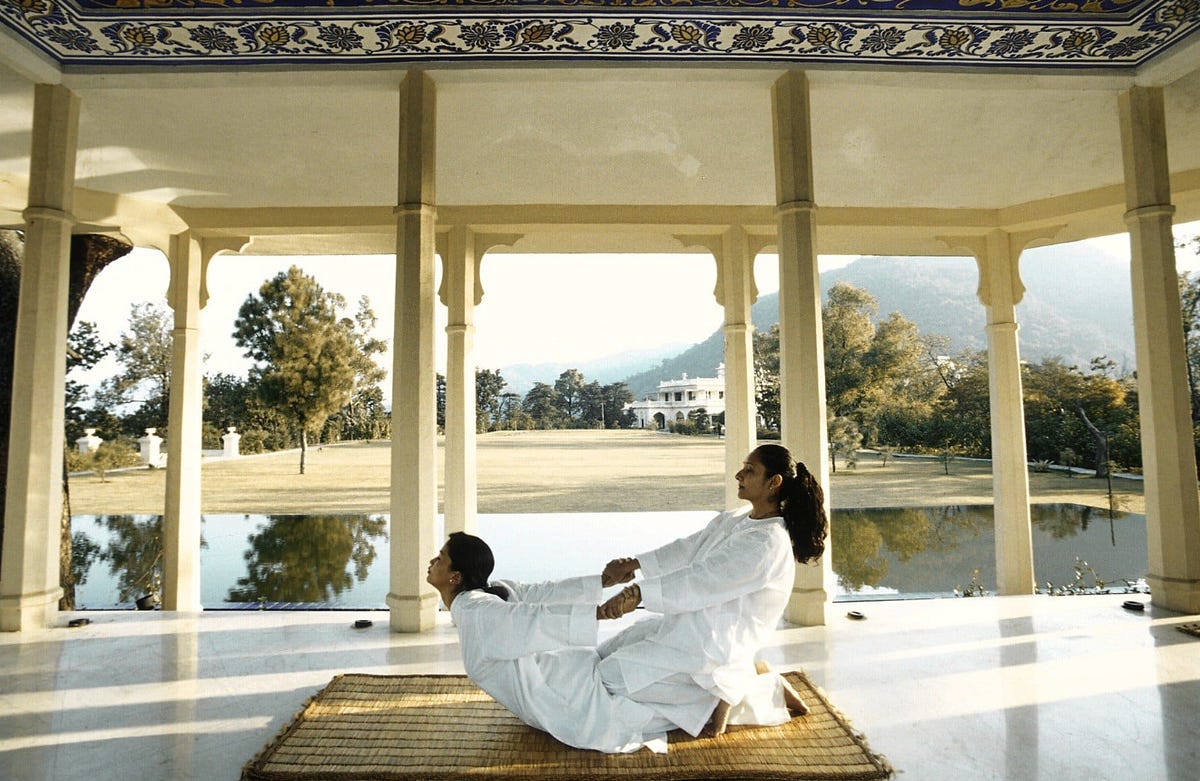
The philosophy combines Ayurveda, yoga, meditation, movement, nutrition, and emotional wellbeing in a way that supports rest rather than constant stimulation.
Sleep and recovery are deeply connected to this approach.
The retreat recognises that many people today live in a near continuous state of mental and physiological activation, often without fully realising it.
At Ananda, wellbeing begins by creating the conditions for rest, recovery and stress regulation.
Wellness & restoration
Programmes are designed to support physical, emotional, and mental recovery through gentle and integrative practices.


Experiences include:
• Guided yoga and meditation
• Breath work and relaxation practices
• Ayurvedic therapies and treatments
• Sleep and stress management support
• Nutrition focused on balance and nourishment
• Spa and hydrotherapy experiences
• Nature immersion and quiet reflection
The approach is not based on intensity or optimisation, but instead on restoration.
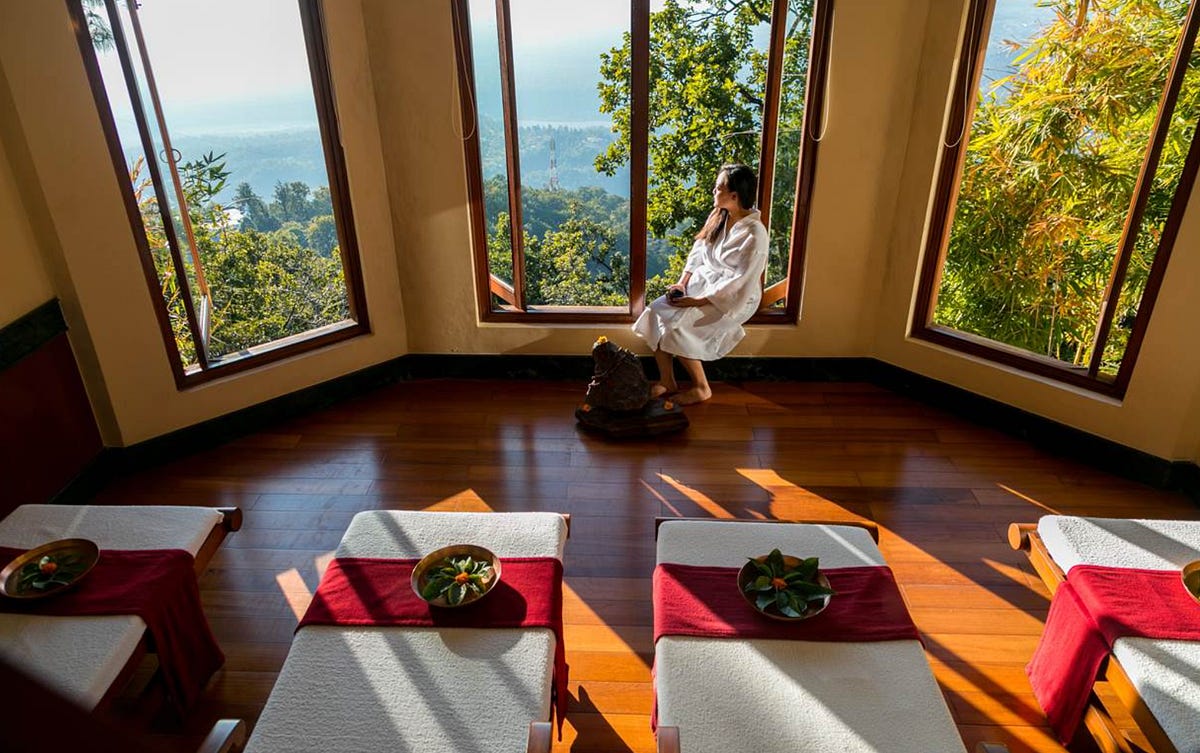
Within the spa, guests have access to sauna and steam rooms, along with cold plunge pools that complement the therapeutic treatments and help stimulate circulation and recovery.
Movement & daily rhythm
Movement at Ananda is approached with balance and mindfulness.
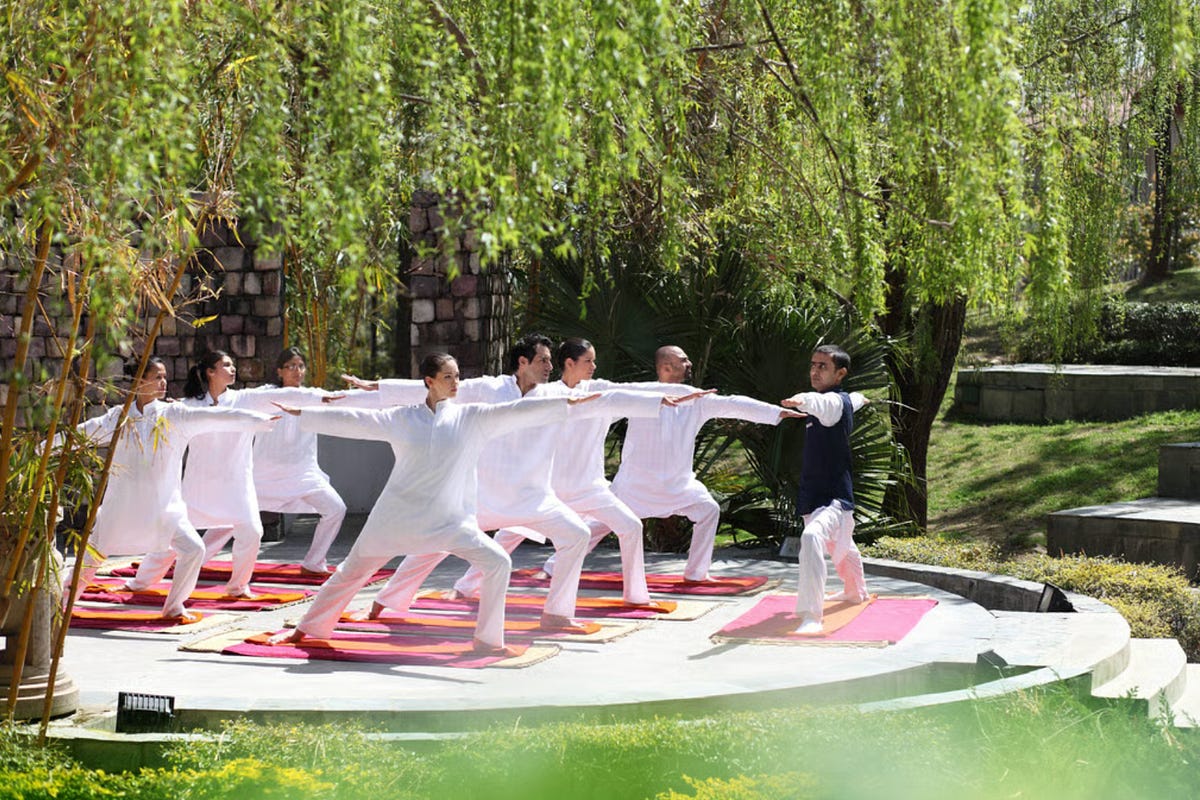
Yoga, walking, stretching, meditation, and gentle fitness sessions are integrated into a slower daily rhythm designed to support recovery rather than overstimulation.
The quieter pace naturally encourages deeper rest and more restorative sleep.

The serene outdoor pool overlooks the surrounding hills, creating a space for relaxation as well as gentle movement.
The fitness centre is spacious and well equipped, allowing for both strength training and cardiovascular exercise.
Nourishment
Nutrition is an integral part of the experience and is approached with the same level of personalisation as the treatments. Meals are thoughtfully designed according to each guest’s Ayurvedic profile, with menus adapted to support their specific goals, whether that is rebalancing, detoxification, weight management, or overall vitality.

Rooted in Ayurvedic principles, the cuisine takes into account the three doshas, Vata, Pitta, and Kapha, which reflect different mind body constitutions. Dishes are carefully composed to help restore balance, using fresh, seasonal ingredients and gentle preparation methods that support digestion and nourishment.
Why choose Ananda in the Himalayas
• Strong focus on sleep quality, stress regulation, recovery, and emotional wellbeing
• Peaceful Himalayan setting immersed in nature
• Integrative approach combining Ayurveda, movement, meditation, and nutrition
• Personalised programmes tailored to individual health goals
• Environment designed to promote calm and deep relaxation
• Emphasis on slowing down and reconnecting with natural rhythms
How to get there
Ananda in the Himalayas is located near Rishikesh in Uttarakhand, northern India, approximately one hour from Dehradun Airport. Transfers can be arranged directly through the retreat.

**If you feel inspired to explore wellness travel, I’d be delighted to help guide you toward a destination aligned with your health and wellbeing goals. Feel free to get in touch anytime.Sources & Further Reading:
- Han X, Zhou E, Liu D. Electronic Media Use and Sleep Quality: Updated Systematic Review and Meta-Analysis. J Med Internet Res. 2024 Apr 23;26:e48356. doi: 10.2196/48356. PMID: 38533835; PMCID: PMC11077410. >> electronic media+++
- Lemyre A, Belzile F, Landry M, Bastien CH, Beaudoin LP. Pre-sleep cognitive activity in adults: A systematic review. Sleep Med Rev. 2020 Apr;50:101253. doi: 10.1016/j.smrv.2019.101253. Epub 2019 Dec 17. PMID: 31918338.
- Anderson AR, Ostermiller L, Lastrapes M, Hales L. Does sunlight exposure predict next-night sleep? A daily diary study among U.S. adults. J Health Psychol. 2025 Apr;30(5):962-975. doi: 10.1177/13591053241262643. Epub 2024 Jul 30. PMID: 39077837.
- Nikola Chung & Yu Sun Bin & Peter A. Cistulli & Chin Moi Chow, 2020. "Does the Proximity of Meals to Bedtime Influence the Sleep of Young Adults? A Cross-Sectional Survey of University Students," IJERPH, MDPI, vol. 17(8), pages 1-12, April.
- Okamoto-Mizuno K, Mizuno K. Effects of thermal environment on sleep and circadian rhythm. J Physiol Anthropol. 2012 May 31;31(1):14. doi: 10.1186/1880-6805-31-14. PMID: 22738673; PMCID: PMC3427038.
- Howatson G, Bell PG, Tallent J, Middleton B, McHugh MP, Ellis J. Effect of tart cherry juice (Prunus cerasus) on melatonin levels and enhanced sleep quality. Eur J Nutr. 2012 Dec;51(8):909-16. doi: 10.1007/s00394-011-0263-7. Epub 2011 Oct 30. PMID: 22038497.
- Afaghi A, O'Connor H, Chow CM. High-glycemic-index carbohydrate meals shorten sleep onset. Am J Clin Nutr. 2007 Feb;85(2):426-30. doi: 10.1093/ajcn/85.2.426. Erratum in: Am J Clin Nutr. 2007 Sep;86(3):809. PMID: 17284739.
- Hieu TH, Dibas M, Surya Dila KA, Sherif NA, Hashmi MU, Mahmoud M, Trang NTT, Abdullah L, Nghia TLB, Y MN, Hirayama K, Huy NT. Therapeutic efficacy and safety of chamomile for state anxiety, generalized anxiety disorder, insomnia, and sleep quality: A systematic review and meta-analysis of randomized trials and quasi-randomized trials. Phytother Res. 2019 Jun;33(6):1604-1615. doi: 10.1002/ptr.6349. Epub 2019 Apr 21. PMID: 31006899.
Featured destination